
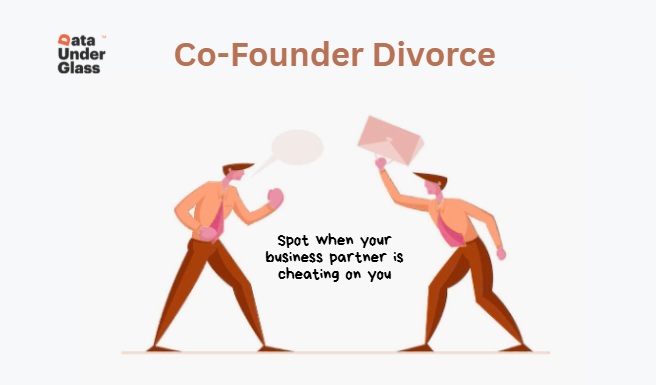
The 65% Killer: Co-Founder Collapse Prevention OS
Welcome back to Data Under Glass, your weekly deep dive into real operator execution, where the focus is not on theory but winning outcomes.
As a media co-founder, over the past few years, I’ve covered and investigated co-founder conflicts that cost companies millions in lost valuation. The pattern is unmistakable: 65% of startup failures trace back to toxic co-founder relationships, not market conditions.
Your co-founder choice is statistically more dangerous than timing or capital. 45% of teams break up within four years.
Today, you’re getting the Partnership Survival Framework. Why founders co-found despite risks, how conflicts manifest, spotting when your partner wants you out, and the operational systems that helped teams like Paystack survive $200M+ exits.
— Anderson Oz’.
Case In Point: Healthtech (Seed, $2.1M) with two technical co-founders
Problem: Six months post-raise, Chief Executive Officer (CEO) handling all investor relations without Chief Technology Officer (CTO) co-founder involvement.
The Pattern:
Information asymmetry: CTO removed from investor emails. “I’ll handle the board deck.”
Scope reduction: CTO redefined from “co-founder” to “head of engineering.”
Dilution positioning: CEO pushing option pool restructuring disproportionately affecting CTO stake.
Reality: CEO building board coalition to force discounted CTO buyout. Private dinners positioning CTO as “purely technical, not strategic.”
Intervention:
Communication audit revealed 47 investor interactions CEO conducted alone over 3 months.
Implemented “Sovereignty of Domains”: CEO owns fundraising and business development, CTO owns product and engineering. Strategic decisions require joint sign-off.
Established weekly 30-minute founder reset separate from board meetings.
Outcome:
Partnership survived, product-market fit hit 8 months later and Series A raised at $18M valuation.
Information asymmetry is the first warning sign. By the time one founder is systematically excluded, the relationship is already in crisis.
The solo founder penalty in African markets is severe. Investors view solo founders as single points of failure in volatile environments.
Resource Aggregation
In ecosystems where pre-seed capital is scarce, co-founding often means pooling personal savings to survive the “valley of death.” PiggyVest co-founders (Somto Ifezue, Odunayo Eweniyi, Joshua Chibueze) bootstrapped using funds from their previous venture, PushCV. This funded two years of building before their $1.1M seed in 2018.
Skill Complementarity
The “hacker and hustler” model: one builds, one sells. Paystack founders Shola Akinlade and Ezra Olubi met at Babcock University. Shola focused on business strategy, Ezra on technical architecture. By 2020, Paystack served 60,000+ businesses and was acquired by Stripe for over $200M.
The Emotional Buffer
Building in Lagos, Nairobi, or Cairo is traumatic. Regulatory delays, infrastructure failures, payment uncertainties. A co-founder becomes an emotional shock absorber when customer acquisition costs spike or Series A falls through.
The Data: Two balanced co-founders are 30% more likely to raise institutional investment. But this creates “marriage of convenience” risk—pairing for funding optics rather than true alignment.
71% of breakups stem from differences on company direction. But greed, when it appears, is devastatingly efficient at destroying partnerships.
The CEO Battle
When startups scale, required skills change. The technical founder may not be the right CEO for enterprise sales, but ego refuses the transition. When one founder wants to “flip” (exit early) and the other wants to build legacy, the company paralyzes.
Financial Opacity
Capiter (Egypt, 2022): Board fired brother co-founders Mahmoud and Ahmed Nouh following investigation into financial mismanagement. The company had just raised $33M. Even brothers aren’t immune when one hides financial realities.
The Free Rider Problem
One founder works 80 hours weekly, the other 40, but both want equal equity. This resentment festers until investor diligence reveals the contribution imbalance.
Sheer Greed
A founder convinces themselves the company belongs to them more. They start repositioning their partner as “less strategic.” They hijack board access, hoard opportunities, and slowly rewrite the narrative until a buyout feels “reasonable.”
You may also enjoy reading: Category Kings: How Flutterwave Created a Market That Didn’t Exist
Information Asymmetry: Removed from investor email loops. New WhatsApp groups created without you. “I didn’t want to bother you” is the most dangerous sentence in a partnership.
Scope Reduction: Your title or role is subtly redefined or completely overhauled. “Focus on product, let me handle strategy.” This cuts your leverage before buyout conversations.
Board Channeling: Private dinners with board members without you. Building coalition to outvote on critical decisions.
Dilution Talks: Aggressive option pool restructuring disproportionately affecting your stake, justified by “industry best practices.”
Unilateral Decisions: Strategic moves made without your knowledge. When confronted: “Oh I thought I told you” or “It was urgent, needed an agile approach.” Hiring, partnerships, budget allocation—suddenly nothing requires your input.
Strange Unplanned Audits: “We need to review what everyone is doing.” These audits exist to find flaws and loopholes to weaponize against you during exit negotiations.
Isolation from Key Stakeholders: Systematically excluded from meetings with investors, major clients, or strategic partners. Your co-founder starts running 1:1 check-ins with team members who previously reported to you.
Hiring and Staff Churn: Personnel you trust are suddenly reassigned, marginalized, or pushed out. New hires come from your co-founder’s network and report only to them.
If you’re experiencing three or more simultaneously, you’re not being paranoid. You’re already in an exit process.
Paystack: Shola owned business strategy, Ezra owned technical architecture. They respected ownership even when disagreeing.
The Rule: Align on direction, not on every decision. Co-deciding everything is exhausting, not collaborative.
Define (early) who owns:
One owner + Shared visibility = Clear boundaries.
Two single people can be excellent co-founders but wait until they marry; new voices enter and new expectations form.
Their relationship didn’t strain because of business problems, but because they had no structured rhythm to reset, clarify, and align when life around them changed.
Same time every week: Thirty minutes that saves million-dollar relationships.
Discuss: Wins, numbers, priorities, decisions, tensions, commitments.
This keeps 7-day-old issues from becoming structural resentment. PiggyVest kept this rhythm even when the app hit millions of users.
Partnerships die not from conflict but from unspoken conflict. You need a framework for hard conversations, not courage alone.
Most partnerships fail because founders never learn to communicate under stress. Communication under pressure is operational infrastructure, not soft skills. It’s as critical as hiring or revenue.
PiggyVest founders failed at eight previous startups together before succeeding. They knew each other’s failure modes and built explicit communication protocols from hard-won experience.
Dynamic Equity with Milestone Vesting: Tie equity to product-market fit, revenue milestones, technical deliverables. Not just four-year survival.
Shotgun Clause: If Co-Founder A offers buyout at X price, B must accept OR buy A at X. Prevents low-balling.
Founders’ Agreement Before First Code: Detail what happens if one underperforms. PiggyVest founders did this after eight failures taught them the cost of ambiguity.
Third-Party Mediation: Don’t resolve equity disputes over drinks. Bring in neutral mentor before conflicts escalate.
Weekly Reset: 30 minutes prevents life transitions (marriage, children, family pressure) from destabilizing partnership without your awareness.
Friend-founder dynamic is most common in Africa (schoolmates from Obafemi Awolowo University, University of Lagos, University of Cape Town).
The Risk: You avoid difficult conversations to “save friendship,” which ultimately kills both business and friendship.
PiggyVest Strategy:
Explicit Role Assignment: CEO, Chief Operating Officer (COO), Chief Marketing Officer (CMO) based on demonstrated capability during PushCV, not friendship seniority.
Public Accountability: Odun’s Twitter presence and Somto’s product focus created external accountability. They couldn’t hide underperformance from each other when users and investors saw execution gaps.
Be That Partner First: Strong partnerships require showing up as mature operators. Clear ownership works when you let go of control. Communication works when you listen. Weekly meetings work when both commit.
✓ The 65% Reality: Toxic co-founder relationships kill more startups than market timing or capital access.
✓ 45% Four-Year Breakup: Nearly half of co-founder teams split within four years.
✓ 71% Vision Misalignment: Most breakups stem from company direction differences, not greed or betrayal.
✓ 30% Funding Advantage: Two balanced co-founders are 30% more likely to raise, creating incentive to partner for optics.
✓ The Number: 43% — Percentage of entrepreneurs who part ways because of internal arguments.
✓ Signal: Paystack and PiggyVest survived through sovereignty of domains and weekly resets implemented early.
✓ Noise: “We’re best friends so we’ll figure it out.” Friendship without operational structure accelerates conflict under stress.
Co-founder selection is your highest-leverage decision.
65% of startups fail from toxic partnerships. The pattern repeats: information asymmetry, scope reduction, board channeling, forced buyout.
Paystack and PiggyVest succeeded not because founders avoided conflict, but because they built systems that survived it.
Before signing:
The answer determines whether you build Paystack or become the 65%.
Your friendship won’t save your startup, your operational systems will.
Data Under Glass is an exclusive weekly deep-dive analysis uncovering the data-driven stories behind the most successful scale-ups. We surface the patterns your pitch deck doesn’t capture and the risks your Excel model can’t see.
Share this with the founder about to partner with their best friend without clarity.
Till next time, this insight is DUG Weekly!