
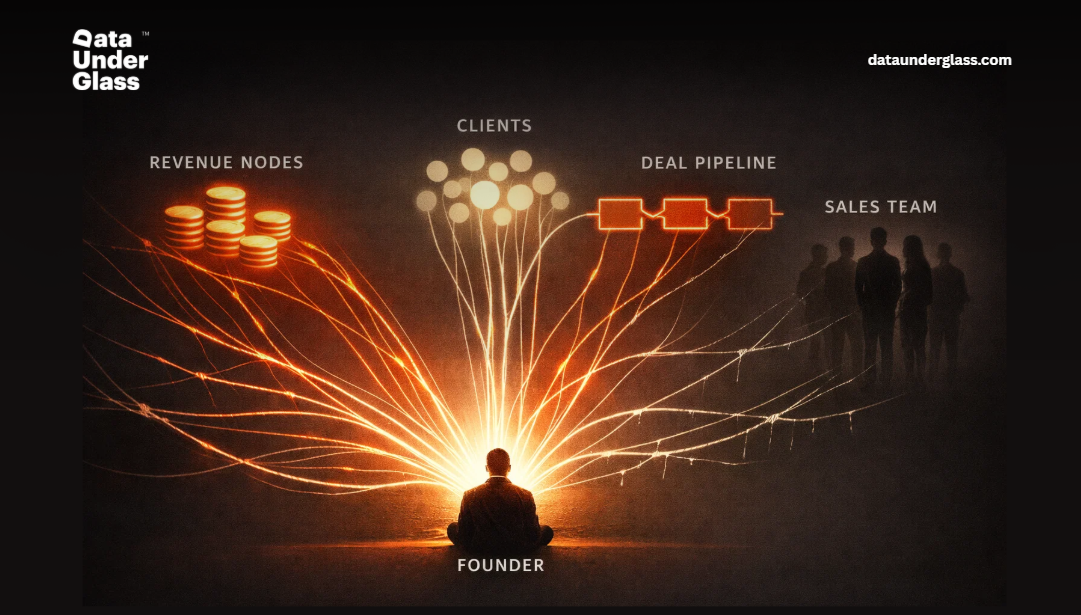
If the system that built your company is invisible, undocumented, and exists solely between your ears, you aren’t scaling a business; you’re postponing a 25% revenue collapse the moment you hire a “real” sales leader. Research shows the VP of Sales’ average tenure has plummeted from 26 months to just 17-19 months, often shorter than the sales cycle of enterprise deals they were hired to close. For operators in high-stakes markets, the transition from founder-led to team-led sales isn’t a maturity milestone; it’s the most dangerous structural fault in a company’s lifecycle.
—Anderson Oz’.
Case in Point: Last year, a B2B supply chain intelligence company at $7.3M ARR in Vancouver hired a VP with “strong pedigree” from an $80M firm. The model forecasted 2x pipeline acceleration.
What Broke:
The Intervention: They reverse-engineered the “trust established” moment in every historic deal. Built reference story library and formal “Board Introduction Protocol.”
The Outcome: VP re-closed three stalled deals in 30 days. Pipeline conversion improved 38%.
The Lesson: 70% of companies experience >25% revenue decline in twelve months following founder-to-team transition. Founder relationship networks account for 40-65% of closed ARR below $10M. Without a formal trust architecture, you’re amputating your revenue engine.
17-19 months: Average VP of Sales tenure, down from 26 months a decade ago
<18 months: Average commercial leader tenure at growth companies
>25%: Revenue decline experienced by 70% of companies in twelve months post-founder-to-team transition
71%: Pipeline stuck in “late stage” when VP lacked the founder’s trust in the architecture
38%: Pipeline conversion improvement after codifying trust mechanics
40-65%: Percentage of closed ARR from founder relationship networks in sub-$10M companies
Most companies transfer the wrong components during VP onboarding. They focus on product features and the noise, while ignoring trust mechanics.
Transferable:
Non-Transferable:
For the Vancouver operator, the founder closed through board-level introductions and published credibility signaling institutional security. VP had none of this. He sold the product while the founder sold trust.
In the Canada-Africa corridor, this magnifies 3x. In relationship-heavy markets like Nigeria or Kenya, trust-mediated sales cycles are 3.1x longer when the founder, the “trust carrier” is removed. Western playbooks relying on directness collapse in African enterprise environments where deals happen only after mutual trust through informal consensus.
If your VP runs the Western transactional playbook in Lagos without the founder’s cultural halo, the deal won’t slow down; it will evaporate.
You may also enjoy reading: The Expatriate Trap: When Global Talent Fails Local Reality.
1. Reverse Deal Engineering: Before hiring a VP, document the last ten deals: exact lead source, specific reference story that closed them, the “trust underwriter” who gave an invisible nod. Companies conducting formal sales codification before VP hire report 41% higher first-year close rates.
2. The 90-Day Trust Architecture Build: Create a reference story library documenting exact moments buyers shifted from skeptical to committed. Build formal protocols for leveraging the founder’s network without requiring presence.
3. Stage-Fit Over Pedigree: Leaders who scaled $20M to $50M struggle building from scratch at $1M. Prioritize stage-fit experience over brand names.
1. Relationship Capital Assessment: What percentage of closed ARR came from your personal network? If >40%, you haven’t built transferable sales architecture; you’ve built dependence on relationships only you can access.
2. Trust Transfer Documentation: Can you identify the exact moment in each deal where the buyer shifted from skeptical to committed? If not, you can’t teach VP to replicate it.
3. Pipeline Paralysis Test: If >50% of VP’s pipeline is stuck “late stage” while you’re still closing deals, they’re missing trust architecture. They have features but lack institutional credibility that neutralizes buyer fear.
4. 18-Month Timer: VP tenure is 17-19 months. If you haven’t built relationship infrastructure within the first six months, they’ll burn out, and you’ll revert to founder-led sales.
Signal:
Noise:
In enterprise, especially high-stakes markets, products are commodities; trust is the only high-margin asset. If your sales process cannot function without your personal CEO-to-CEO blessing, you haven’t built a sales team; you’ve built an audience for your ego.
The provocative reality: While competitors watch 25% revenue collapse during VP handoff, operators who reverse-engineered trust architecture run organizations where VPs convert pipeline at founder-level rates.
The hard truth: You are the bottleneck and the solution.
Most newsletters tell you what’s trending. DUG Weekly tells you what happened, why it did, and what it means for your next decision. Every week, we deliver a forensic analysis of why companies actually scale or collapse. Not news. Not motivation. Not theory.
Forward this to a founder who just hired their first VP of Sales and hasn’t yet documented why they personally close deals.
The data doesn’t lie. The markets do.
Keep digging—till next time, this is DUG Weekly!